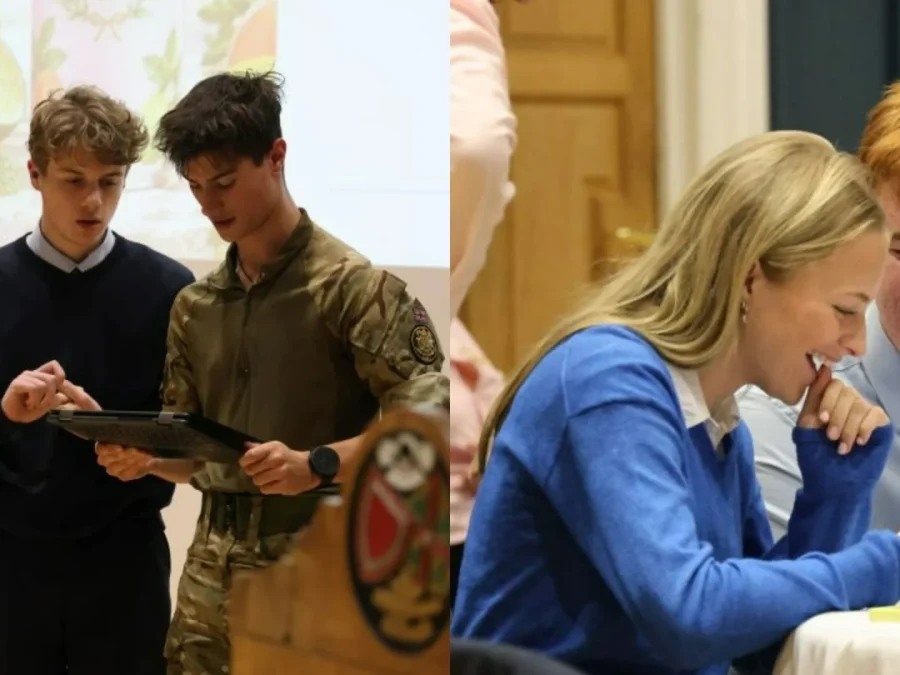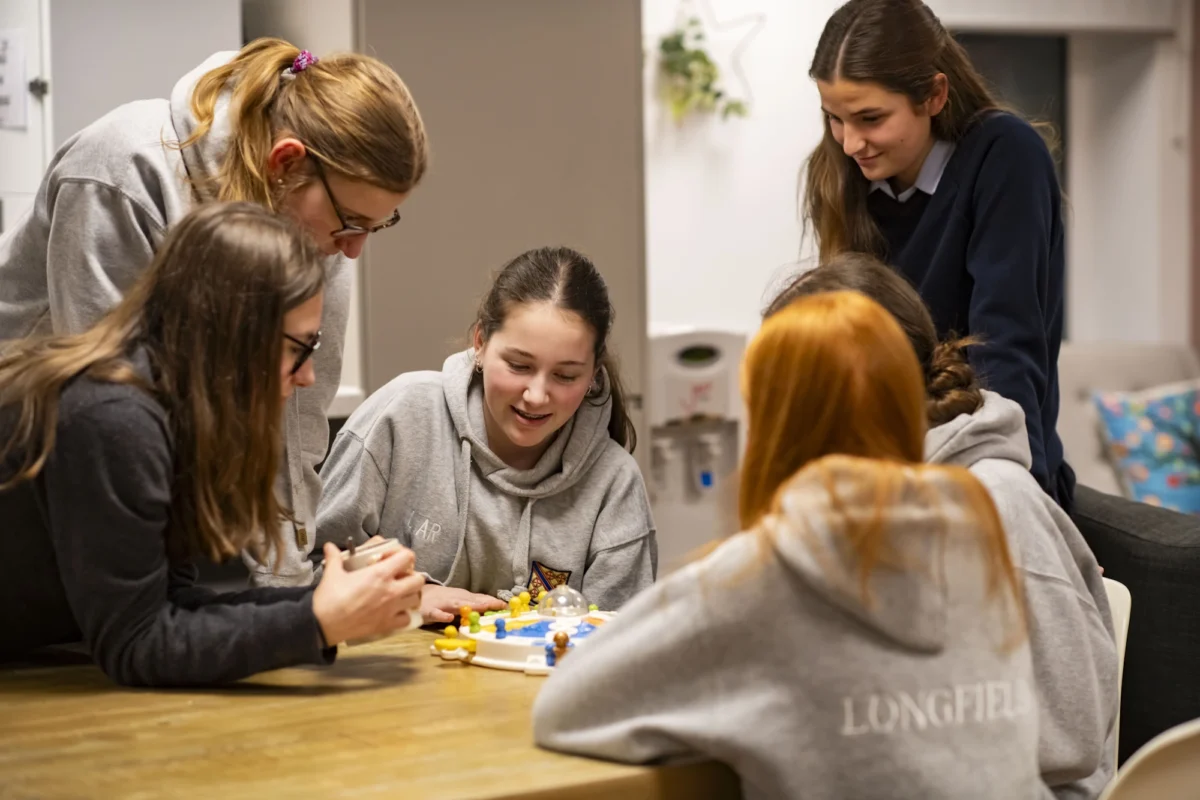



Barnard Castle School is an inclusive community that is committed to promoting the wellbeing of all students by supporting them to be physically and mentally healthy, able to cope with life’s challenges in a positive and constructive way. We want every pupil to be happy and to flourish. A flourishing pupil is one who feels safe, known and supported, and who is able to reach their potential both in the classroom and beyond.
We take a whole-person approach to pastoral care and work in close partnership with parents to provide the best possible support at school and at home.
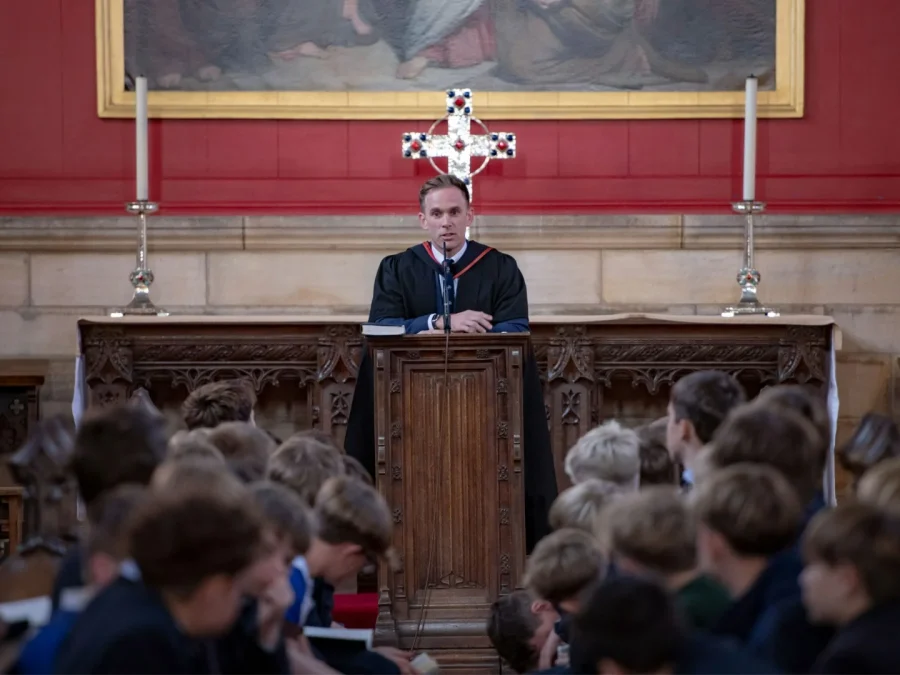
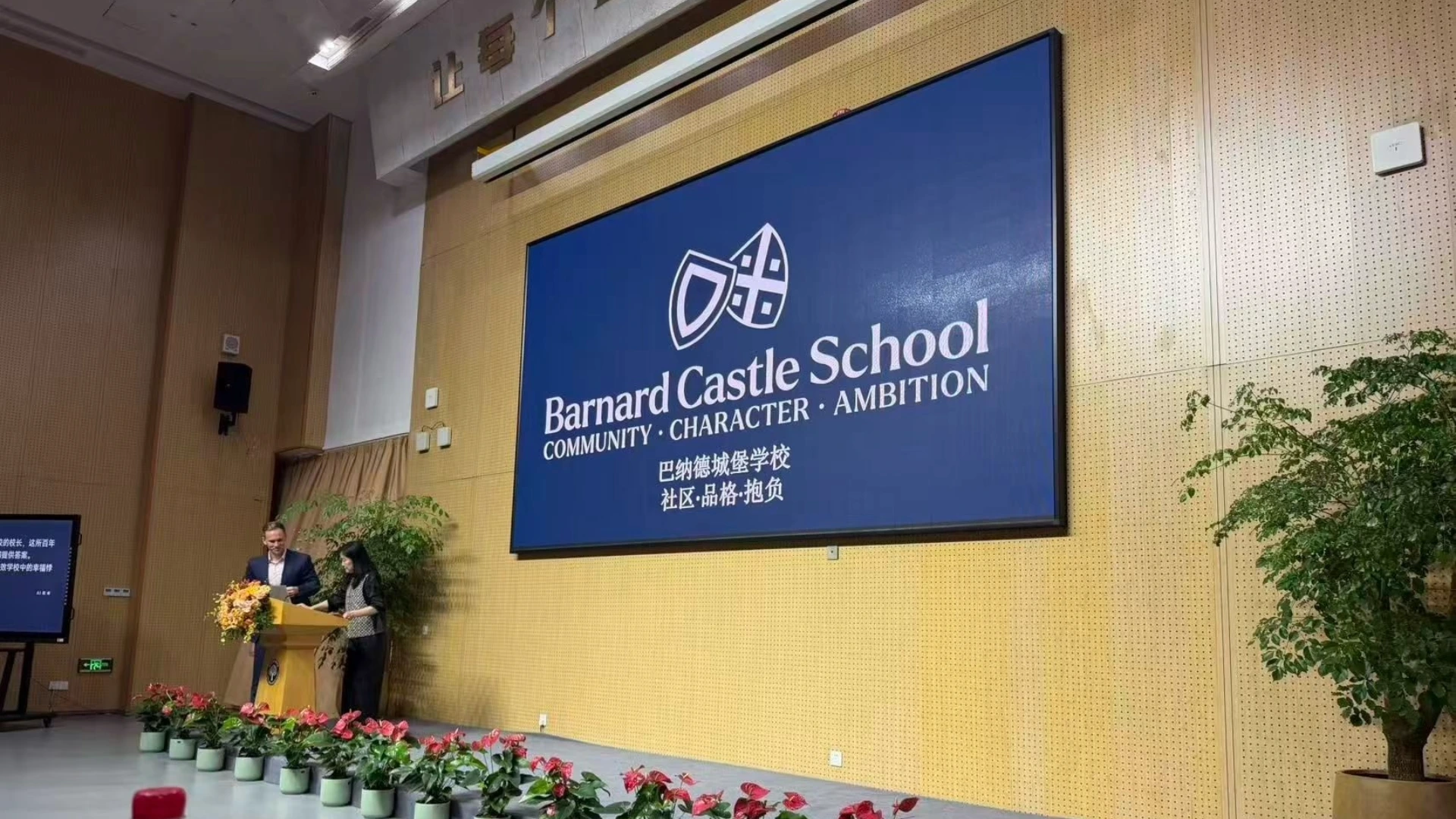
As we started the second half term, and students returned to school from Scotland, Greece and Norway, Headmaster David Cresswell also returned from his own trip to Hangzhou, China.
Over half term, the Headmaster was invited to speak at a conference; please see a copy of his speech, The Paradox of Wellbeing, below.
A false choice
It is a great privilege to be with you in Hangzhou.
I come from Barnard Castle School in the north of England. We are an ambitious school. We believe in academic excellence. We believe in hard work, high expectations, discipline and the pursuit of improvement.
So I want to begin today with what may sound like a contradiction.
What if one of the best ways to improve academic performance is to stop thinking only about academic performance?
And what if wellbeing is not the opposite of high performance, but one of its essential conditions?
That is the paradox I want to explore with you.
When we talk about wellbeing in schools, it is very easy for the conversation to become separated from the central work of education. There is academic achievement over here, and wellbeing over there. One is rigorous; the other is supportive. One is about standards; the other is about happiness.
I increasingly believe this is a false choice.
At Barnard Castle, our experience is leading us towards a different proposition:
Students who understand themselves are better able to manage themselves. Students who can manage themselves are better able to learn. Students who can learn effectively are better able to perform – not simply for one examination, but over time.
So my argument today is not that we should expect less of young people. It is that if we understand them better – and help them understand themselves better – we can expect more.
And this is not simply a philosophical position. A major meta-analysis by Durlak and colleagues examined 213 school-based social and emotional learning programmes involving more than 270,000 students. Compared with control groups, participating students improved in social-emotional skills, attitudes and behaviour, and showed an 11-percentile-point gain in academic achievement.
We should be careful with the claim: this is evidence for well-designed social and emotional learning, not proof that anything labelled “wellbeing” raises grades. But it does challenge the assumption that attention to social and emotional development necessarily takes us away from academic learning.
We may be creating the conditions in which learning happens better.
1. What do we mean by high performance?
I come to education partly through the experience of high-performance sport. Sport taught me something important: high performance is not producing one exceptional performance. It is being able to perform repeatedly, under pressure, when circumstances are difficult.
That requires technical skill. But it also requires something else. You have to recognise what is happening inside you. You have to manage disappointment. You have to recover from mistakes. You have to work with other people. You have to remain confident when things are going badly. You need to know when to push and when to recover. And perhaps most importantly, you need a reason to keep going.
Those are not simply sporting skills. They are human skills – and they are learning skills.
Wellbeing is not simply feeling good. It is developing the capacity to function well.
A high-performing school therefore should not be a school without struggle. Quite the opposite. Young people need challenge. They need difficulty, disappointment and sometimes failure. The question is whether they have the internal resources and external support to respond productively to that challenge.
In my own thinking about education, I have come to a simple formulation: high challenge plus high support creates the conditions for growth. Support without challenge can create comfort. Challenge without support can create fear. Put the two together and something very powerful becomes possible.
2. Know yourself: emotional literacy as a performance skill
The first idea I would like you to take away is simple: better learners understand themselves better.
This is where the work of Dr Marc Brackett at the Yale Centre for Emotional Intelligence, and his book Permission to Feel, has been particularly influential on our thinking at Barnard Castle.
Brackett’s RULER approach develops five emotional skills:
Recognising emotion; Understanding its causes and consequences; Labelling it accurately; Expressing it appropriately; and Regulating it effectively.
Think about a student preparing for an important examination. Imagine that student saying: “I can’t do mathematics.” That sounds like an academic judgement. But perhaps the real statement is: “When I encounter a problem I cannot immediately solve, I become anxious. I interpret that anxiety as evidence that I am not good at mathematics. So I withdraw.”
Those are two completely different educational problems. The first seems to require more mathematics. The second requires greater self-awareness.
“I am experiencing anxiety” is different from “I am incapable.”
Once the student can recognise what is happening, a small but important space opens between the emotion and the response. Emotional regulation does not mean teaching children not to feel anxiety. It means helping them recognise it, understand it and choose a response that allows them to continue functioning effectively.
Emotional intelligence is a performance skill.
So here is a practical takeaway for tomorrow. When a student is struggling, do not only ask: “What don’t you understand?” Also ask: “What is happening to you as you try to understand it?”
3. Belong: safety makes challenge possible
But self-awareness does not develop in isolation. It develops through relationships.
One of the strongest convictions in my educational philosophy is this: children flourish when they feel connected, capable and needed.
Notice that I say needed, not simply included. We often think schools create belonging automatically. We have classes, groups, teams, clubs and assemblies. But belonging is not the same as membership. A student can be surrounded by hundreds of other children and still feel invisible.
Belonging must be designed.
I want every young person eventually to be able to answer three questions:
Who notices me? Where do I matter? What am I good at that is valuable to other people?
This matters morally, but it matters educationally too. A meta-analytic review of 82 studies in secondary education found school belonging positively associated with academic achievement and, even more strongly, with motivation, self-concept, self-efficacy and engagement; it was negatively associated with absence and dropout. Much of this literature is correlational, so we should not pretend belonging is a simple lever that automatically produces grades. But the pattern is important.
Belonging is part of the learning environment.
Emotional safety does not mean removing challenge. Safety means I can take the risk of being challenged. I can put my hand up when I am uncertain. I can give an answer that might be wrong. I can ask for help. I can receive feedback without interpreting it as an attack on my identity. I can try very hard without worrying that my peers will laugh at me for caring.
One sentence from my own leadership philosophy matters greatly to me: students should feel safe to try – and safe to look like they are trying.
Is it socially safe to care about succeeding in your classroom?
Look at your class not simply as a group of learners, but as a network of belonging. Who is visible? Who is valued? And who could disappear without anybody noticing? That third student is the one schools must become much better at finding.
4. Discover your strengths: make it safe to be wrong
There is another dimension to wellbeing that schools sometimes overlook: young people need opportunities to discover themselves.
Sir Ken Robinson spent much of his career arguing that human ability is more diverse than traditional education systems sometimes allow. In his 2006 TED talk, he made a point that has stayed with many educators: children are often prepared to take a chance, but over time they can become frightened of being wrong. His argument was not that being wrong is the same as being creative. It was that originality requires the willingness to risk being wrong.
You cannot have high performance without the possibility of failure.
You cannot write an outstanding essay without first writing an imperfect one. You cannot solve genuinely difficult problems without sometimes getting them wrong. You cannot become an excellent musician without playing badly. You cannot lead without occasionally making the wrong decision. And you cannot discover what you are capable of if you only do things at which you already know you will succeed.
So perhaps one of the most important forms of psychological safety in a school is this: it must be safe to be wrong. Not careless. Not unprepared. But genuinely, courageously wrong.
Robinson’s work also connects to something I believe deeply about breadth. Schools can become very good at recognising a particular kind of success: the highest examination score, the best mathematician, the first-team captain, the student standing on the stage. But what about the student whose great strength has not yet been discovered? The student who brings people together? The student who can build something? The musician, the designer, the organiser, the quiet problem-solver?
My own experience was that sport, drama and music gave me different arenas in which to belong and contribute. That breadth helped shape my identity. I think schools should help every child find an arena in which they can discover that they are capable and that their contribution matters.
“I am good at something” can become “I can become good at something.”
That is not lowering academic expectations. It is broadening the foundations from which confidence and ambition can grow. So ask: where does this child experience competence? If the answer is nowhere, perhaps our first job is to help them find it.
5. Find purpose: motivation must eventually become internal
There is one final part of the puzzle. Why does a young person choose to work hard when no adult is standing beside them? Why practise? Why revise? Why persevere with something difficult? Sustainable high performance eventually requires motivation to become internal.
Self-Determination Theory, developed by Edward Deci and Richard Ryan, gives us a useful framework. It identifies three basic psychological needs:
autonomy – a sense of volition and ownership;
competence – a sense that I can become effective;
and relatedness – a sense of connection and belonging. Contexts that support these needs are associated with higher-quality motivation, engagement, persistence and performance.
For students, we might translate those ideas very simply: I have a voice. I can get better. I belong here.
And I would add another word from my school’s own experience: purpose. Why does this matter? Why should I learn this? Who might benefit from what I become capable of doing?
Education cannot only be about accumulating achievements. Young people eventually have to answer a much more difficult question: what am I going to do with what I have been given?
That is why contribution matters so much in my philosophy of education. My experience through team sport taught me that confidence often grows when another person needs something from us. Contribution builds confidence. Confidence helps build identity. And identity creates a foundation from which greater ambition becomes possible.
6. Four questions for Monday morning
If all I leave you with today is a philosophy, then I have probably wasted your time. So let me make this practical. I would like to suggest four questions —-not another programme, not another initiative – four questions that can change the way we see a child.
1. What am I feeling?
Teach students to name emotions with greater precision. Not simply good, bad, fine or stressed, but frustrated, disappointed, overwhelmed, curious, uncertain, excited or embarrassed. Better emotional vocabulary gives students a better chance of understanding what is happening and choosing a response.
2. Where do I matter?
Every child should have people who notice them and somewhere their contribution matters. For leaders: do not leave this to chance. Look deliberately for the children whom nobody chooses, and create meaningful ways for them to contribute.
3. Where can I grow?
Help students experience the connection between effort, strategy, feedback and improvement. Ask where each child experiences genuine competence – and where they can safely stretch beyond it.
4. Why does this matter?
Give students appropriate opportunities for ownership and purpose. Not unlimited choice, but meaningful agency. Help them connect today’s effort with the person they are becoming and the contribution they may make.
Understand myself → Find my place → Experience growth → Find my purpose
Conclusion: the paradox
We sometimes worry that focusing on wellbeing will make education less demanding. I think the opposite can be true. When wellbeing is understood properly, it gives us permission to be more ambitious for young people.
Resilience is not avoiding difficulty. It is knowing how to respond to difficulty. Emotional intelligence is not removing uncomfortable emotion. It is learning what to do with it. Belonging is not making everything easy. It gives young people the security from which they can take risks. Autonomy is not removing expectations. It helps students internalise them. And support is not the alternative to challenge. Support is what allows challenge to become growth rather than fear.
Wellbeing is not the absence of challenge. It is the capacity to respond well to challenge.
That, for me, is the paradox of wellbeing in a high-performing school.
I began by asking whether we might improve academic performance by thinking about something larger than academic performance. I want to finish with something larger still.
Artificial intelligence is changing education extraordinarily quickly. Knowledge is becoming more abundant. Information is becoming cheaper. Machines are becoming increasingly capable of doing things that schools once regarded as uniquely intellectual. That makes the human purposes of education more important, not less.
Our students will need knowledge. They will need intellectual rigour. They will need excellent examination results. But they will also need to understand themselves; understand other people; build relationships; exercise judgement; find purpose; recover when things go wrong; and contribute to communities larger than themselves.
In my own leadership manifesto, I describe this as preparing young people to become the kind of people others are better for knowing.
Achievement or wellbeing? That is the wrong question.
The better question is: what kind of wellbeing enables a young person to achieve more, sustain it for longer, and still become someone capable of living a fulfilling life?
That is the education I believe we should be trying to build.
Thank you.